

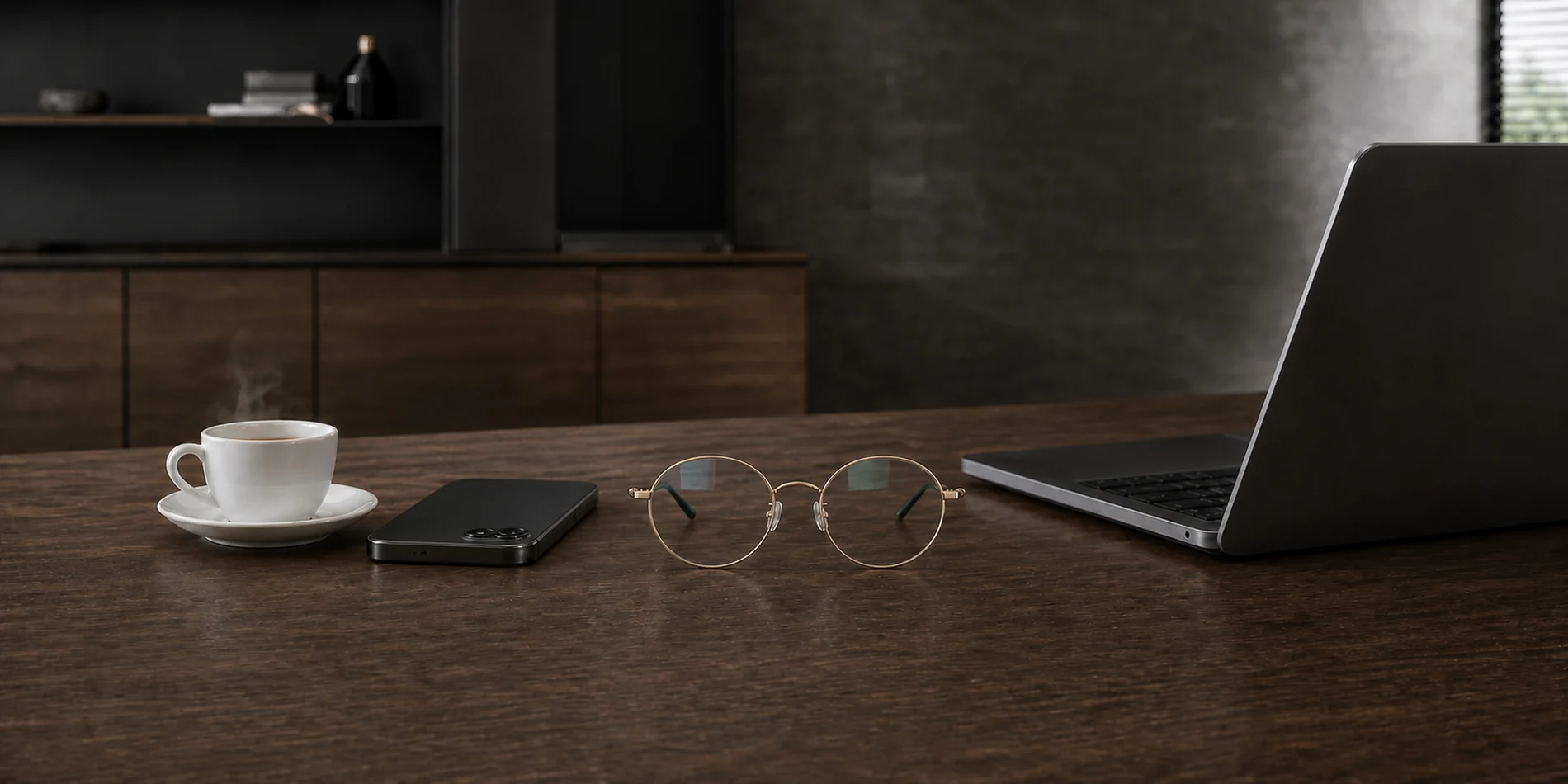
Everyday Glasses · Office Glasses
If words up close keep getting blurrier, office glasses can bring back easy, comfortable focus.
Dedicated lenses optimized for near and intermediate vision let you stay focused longer, without straining your neck and shoulders.
“It is a sad truth, but presbyopia comes for all of us in our 40s. It brings a kind of discomfort we have never felt before — most often, things like your smartphone or paperwork losing their sharpness at close range. So we end up wearing reading glasses or progressive lenses.
But reading glasses are only clear at one fixed distance, so the monitor and the phone all have to be pulled into book range. Progressives let you see both, but glancing from a page up to the monitor means steering a very small power zone with your neck — tiring, and often dizzying too.”
What Are Office Glasses?
Office glasses are dedicated eyewear that optimizes your vision for near and intermediate work within about 20 inches to 13 feet — computer monitors, documents and books. Unlike regular or progressive lenses, they deliberately give up distance vision in exchange for maximum clarity and comfort at the distances you use most during the workday.
They are drawing attention as an alternative for people whose eyes tire quickly at the monitor as presbyopia begins after 40, or who feel their vision swim and get dizzy when wearing progressive lenses.

Why Do I Need Office Glasses?
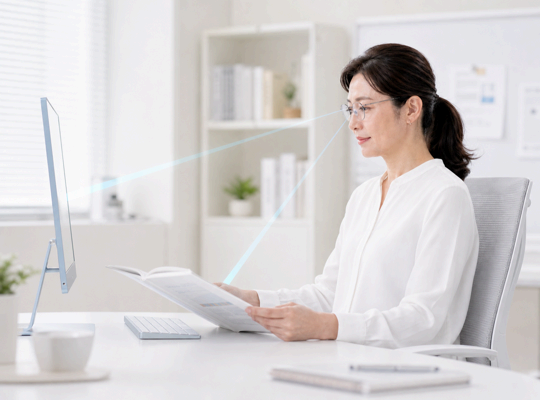
Standard progressive lenses cover everything from far to near, but to see something close like a monitor you have to look through the bottom of the lens — which means holding your head tilted up. Over a workday this builds real fatigue in your neck and shoulders.
Office glasses accept slightly softer distance vision so that everything you need to see indoors stays comfortable — a lens customized to how you actually work.
Posture & Gaze Angle
Reading glasses make you lean in. Progressives make you tilt up. Office glasses let you stay as you are.
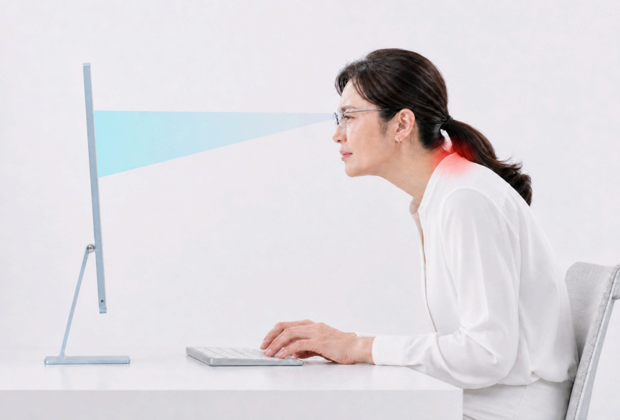
① Regular (near-vision) glasses
Only near objects are clear, so without realizing it you lean your head forward.
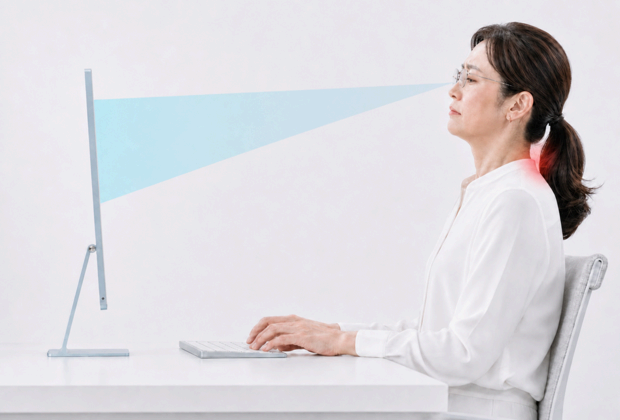
② Progressive lenses
The intermediate zone is narrow, so you have to tilt your head up to see the monitor.

③ Office glasses
No tilting up, no leaning in — the whole monitor, just as it is.
The entire screen falls naturally into view at eye level, so you can stay focused longer without loading your neck and shoulders.
The Benefits
Comfort built around the way you work
Wide field of view
The intermediate zone for viewing a computer monitor is far wider than in a standard progressive, so everything simply feels easier to look at.
Natural posture
Work in a natural position — no tilting your head up or hunching forward just to see the monitor.
Easy to adapt
They do not cause the dizziness of standard progressives, so even first-time wearers adjust quickly.
The Limits of Office Glasses
Four things worth knowing
Limited distance vision
Far away detail is softer, so reading distant text is difficult. As a benchmark: subtitles on a living-room TV more than 10 feet away may not be readable from the sofa.
A set maximum clear distance
Each lens design (e.g. 3 ft, 7 ft, 10 ft) has a limit on the farthest distance it renders clearly. (See the three lens designs below.)
Not for outdoors or driving
They are not suited to situations that need distance vision, like driving or outdoor activities — switch back to your distance glasses for those.
How they differ from readers
Ordinary readers are only clear at a very close 12-16 inches. Office lenses are multifocal, so within their designed range just moving your eyes keeps everything naturally in focus.
Office Lens Types
Three designs matched to your work environment
Each lens's focal distances and field of view are custom-designed around your personal work setup — number of monitors, desk depth, how often you are in meetings, and so on.
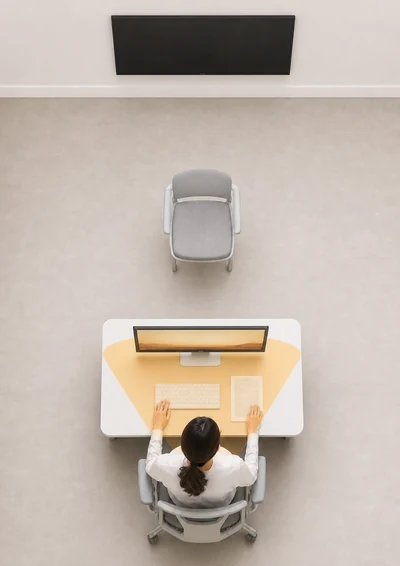
① Near single-vision lens
A lens focused on a single near point (12-20 inches). Suited to fixed short-distance work such as reading or precision tasks.
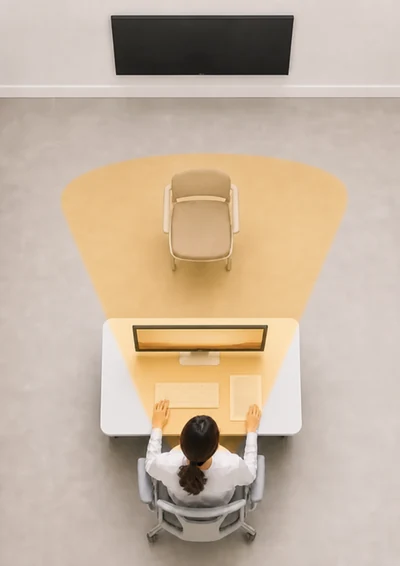
② Mid-range (office) progressive lens
Provides a wide, graduated view from near out to about 7 feet. Glancing from your monitor to a colleague or a meeting-room screen feels natural — the standard office design O Eyecare recommends most.
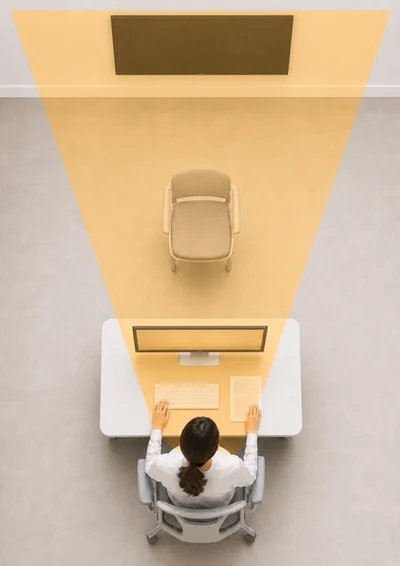
③ Full-time office progressive lens
A premium design that extends your view to distance (about 13 feet) within the office — and further, down the corridor or out the window. Recommended if frequent meetings and presentations keep you looking across the room.
The right office-lens prescription depends on the distances of your main work (one computer monitor, multiple monitors, mostly paperwork, and so on). Tell us about your work environment and your current prescription, and we can recommend the lens type that fits you best.
At a Glance
Regular vs. office vs. progressive lenses
| Category | Regular (single-vision) | Office glasses | Progressive lenses |
| Focus range | Clear at one distance only (far or near) | Near + intermediate (desk to ~7 ft) | Near + intermediate + distance |
| Monitor work | Must lean in or slide the glasses down | Clear with your head held naturally | Narrow intermediate zone forces the head up |
| When to wear | One distance only (outdoor, reading, etc.) | Indoor near work — office and home office | All-day wear, including outdoors |
| Adaptation | Easy | Easy to moderate | Moderate to hard (adjustment period needed) |
| Price range | Relatively low | Mid-range (single-vision-based design) | Relatively high |
| Best for | Correction needed at one specific distance | Days spent mostly on monitor and desk work | Varied distances, indoors and out |
Tip — because office glasses give up distance vision, we recommend keeping your existing glasses (or progressives) for going out and getting around.
Who We Recommend Them For
- Office and remote workers who spend six or more hours a day on monitors and documents
- Anyone whose monitor has started to look blurry as presbyopia sets in
- Those who have felt dizziness or visual swim when wearing progressive lenses
- People with frequent neck and shoulder stiffness whose glasses pull their posture forward
- Anyone looking for a dedicated second pair for office or work-from-home use
Frequently Asked Questions
Common questions about office lenses
Q.Are office glasses okay to wear when I go outside?
A.Office glasses are optimized for near and intermediate distances, so far vision can look soft. For going out and getting around we recommend switching back to the glasses you usually wear.
Q.Progressives made me dizzy and I gave up on them. Will office glasses be just as dizzying?
A.Progressive-lens dizziness mostly comes from compressing the entire far-to-near range into a narrow lens. Office glasses only cover near to intermediate distances, so there is less visual distortion and adaptation tends to be much easier.
Q.Do I need office glasses if I don't have presbyopia yet?
A.Even without presbyopia they can help if long hours of monitor work leave your eyes strained. We will advise you on an exact prescription after an eye exam and consultation.
Q.What does the eye exam involve?
A.We first look at your actual monitor distance, desk environment and work habits, then design the focal distances individually around you. Please book a visit to one of our offices for a consultation.